

⭐Readers Respond — A Parent Speaking Plainly
A conversational narrative based on a real exchange between a parent, Renee Anne, and Koach Karl.
🌱. When a Parent Says, “I See It Differently…”
The message that stopped me cold wasn’t dramatic. It was simple:
“While I think these things are true, I also see it a bit differently.”
After publishing our Four-Part GIRLS series, I received that message from a parent, Renee Anne. She didn’t argue. She didn’t dismiss. She simply offered a wider lens.
So I listened.

⏳. The Burnout Timeline No One Talks About
Renee began with something so simple, so obvious, that it’s almost embarrassing we don’t say it out loud:
“Kids used to start sports around age 10. Now they start at 5. Seven years later, they’re only 12 — and exhausted.”
She’s right.
A 12‑year‑old today has already lived the athletic lifespan of a high‑school senior from 20 years ago.
We call it “development.” But to a child, it feels like a marathon they never agreed to run.
Then she added the line that hit even harder:
“The level we expect now is 100% commitment, year‑round. Kids need a break.”
Not a break from soccer. A break from pressure.
🔀 . The Multi‑Sport Escape Route
Renee pointed out something we often overlook:
Girls aren’t just quitting soccer. They’re choosing something else.
Volleyball. Basketball. Softball. Track. Cross country.
Not because they don’t love soccer , but because other sports offer something soccer rarely does:
“Volleyball girls get a month or two off. Soccer girls don’t.”
In many sports, the rhythm is:
Season → Pause → Club → Pause → Try something else → Pause
In soccer, the rhythm is:
Fall → Winter → Spring → Summer → Camp → Tournament → Repeat
They’re not quitting the game.
They’re quitting the pace.
And this is why formats that slow the game down, simplify decisions, make it fun, and reduce pressure, like Quad‑Goal Soccer, matter more than ever.

🔥. The Pressure to Play “Up” and Play Everywhere
Then came the part that made me sit back in my chair:
“They often play multiple teams and up an age group or two. They love it at the time, but it fizzles out over the long haul.”
We celebrate “playing up” as a badge of honor.
But for many girls, it becomes a slow leak, draining of joy, confidence, and emotional energy.
And Renee didn’t stop there:
“How many volleyball girls play multiple club teams? How many travel all over the state? Soccer is different.”
She’s right again.
Soccer’s culture of constant travel, constant tournaments, and constant evaluation is unique and uniquely exhausting.
❓. The Question That Still Remains
After reading everything Renee shared, I wrote back:
“What I’m trying to understand is why the drop hits girls so much harder, even when the love for the game is there.”
Her response was simple, honest, and deeply human:
“It’s not always about confidence or self‑image. Sometimes they’re just tired.”
Not broken.
Not fragile.
Not disinterested.
Just tired.
And when a child is tired, they don’t need a new program.
They need a new rhythm.
💡. What This Conversation Taught Me
Renee didn’t give me data.
She gave me something more valuable:
Perspective.
Experience.
Truth.
She reminded me that behind every dropout statistic is a child who once loved the game, and a system that slowly wore that love down.
She reminded me that girls aren’t leaving because they’re weak.
They’re leaving because the demands are strong.
And she reminded me that the solution isn’t more intensity, it’s more humanity.
📣. An Invitation to the Soccer Community
If you’re a parent, coach, or leader reading this, I hope you hear what I heard:
- Kids need breaks.
- Kids need balance.
- Kids need variety.
- Kids need joy.
- Kids need childhood.
And girls, especially girls, need us to stop assuming their dropout is a mystery.
Sometimes the answer is simple:
They’re tired.
And they need us to notice.
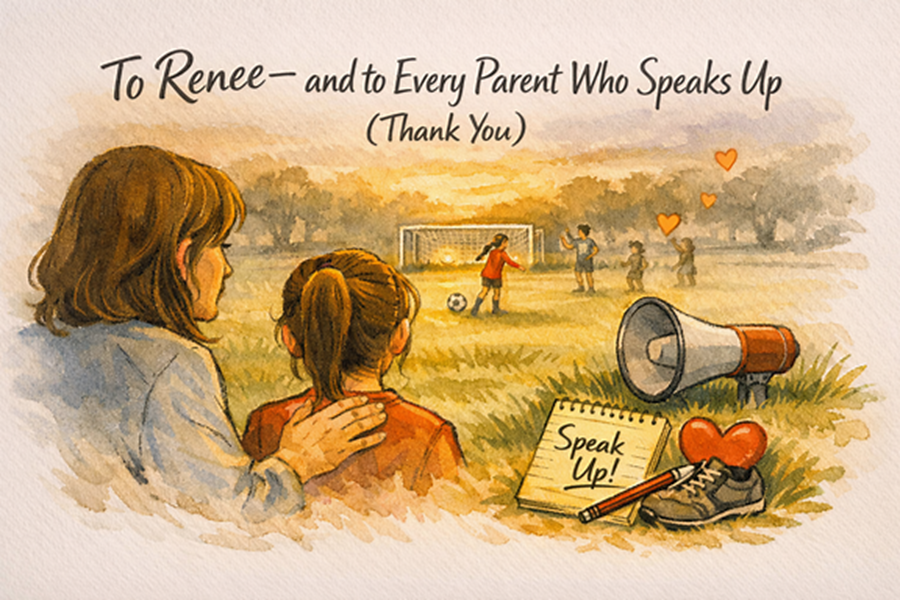
Renee didn’t write to debate.
She wrote to share what she sees.
And parents like her — the ones who speak gently, honestly, and from lived experience — are the reason youth sports gets better.
Every time a parent says, “I see it differently,” they’re not challenging us.
They’re helping us.
They’re widening the lens.
They’re grounding the conversation.
They’re reminding us what this is really about.
Not trophies.
Not rankings.
Not résumés.
Kids.
Their joy.
Their energy.
Their childhood.
And the more we listen to parents like Renee, the better we become at protecting all three.

FINAL WORDS
Your voices after the ‘Four-Part GIRLS Series’ have been extraordinary, honest, brave, and deeply needed.
Renee’s perspective opened a door we don’t walk through often enough: what burnout really looks like from a parent’s seat.
If you’ve seen this in your own family, your team, or your community… your insight matters here.
This conversation is bigger than one article.
It’s bigger than one parents story.
It’s keeping our girls in the game, and keeping their joy intact.
Girls aren’t asking us for more intensity.
They’re asking us to pay attention.
To notice when the joy fades.
To notice when the energy dips.
To notice when the game starts to feel heavier than it should.
And if you, or someone you know, can help in this cause, I hope you’ll reach out.
Let’s work together to build a game our girls can love for a lifetime.💬⚽
