
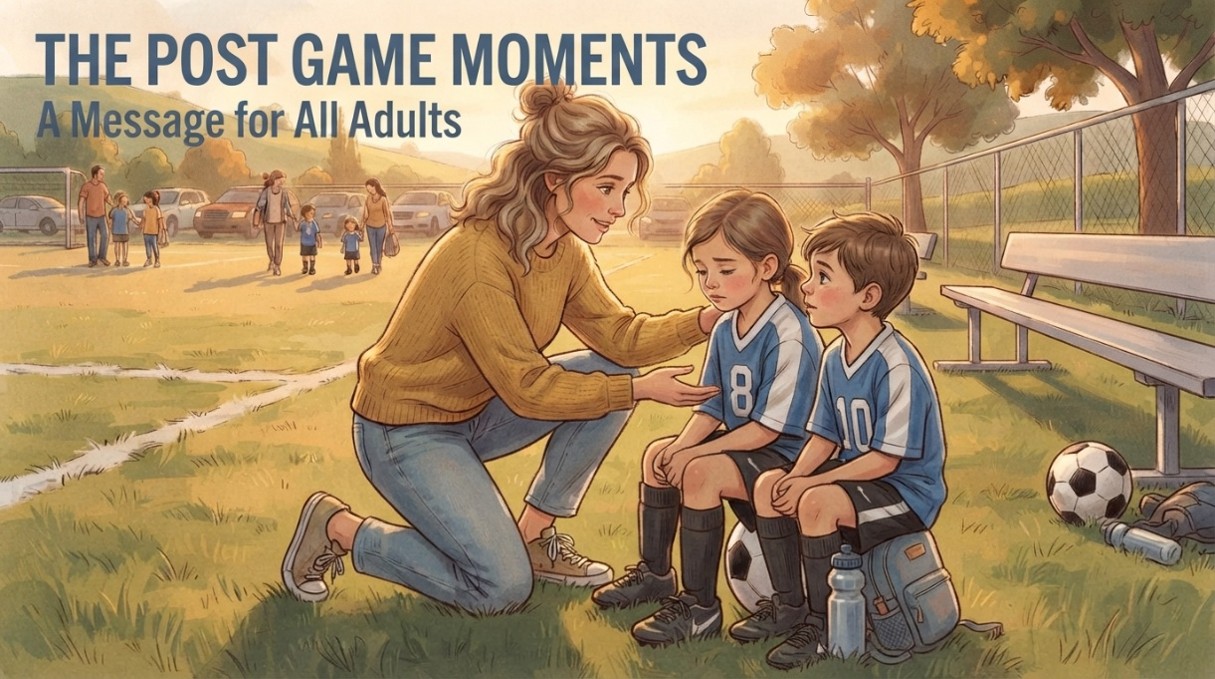
After a youth game, emotions run high — for everyone.
Kids feel everything at once.
Coaches feel everything at once.
Parents feel everything at once.
And here’s the part we rarely say out loud:
Right after a game is the worst time for adults to teach anything.
Not because we don’t care.
But because we care so much that our emotions get loud.
The quiet truth
Most postgame speeches, sideline comments, and car ride “lessons” aren’t really for the kids.
They’re for us — the adults — trying to unload frustration, fix mistakes, or make sense of the last 60 minutes.
But kids don’t learn well when adults are venting.
They learn when adults are calm, clear, and connected.
⭐ What actually helps kids
Kids grow when adults model the thing we want them to develop:
Resilience.
Patience.
Reflection.
Emotional control.
Not by telling them to “toughen up,” but by showing them how we handle tough moments.
⭐ A simple routine for coaches and parents
After the game:
Say only one or two things that are truly about tomorrow.
Not the mistakes.
Not the lecture.
Just the next step.

Write everything else down later — all the things you wanted to say.
Look at that list the next day.
Cross off everything that no longer matters.
You’ll cross off most of it.
And that tells you exactly who those comments were really for.
⭐ The shared adult responsibility
Kids don’t need postgame pressure.
They need postgame safety.
They don’t need adults unloading emotion.
They need adults modeling it.
They don’t need speeches.
They need space.
And they don’t need us to be perfect — just calm enough to let them love the game.
